Behind the Scenes Event Photography and Videography
You have seen the finished stage. The sleek conference hall that looked like it assembled itself overnight. The brand activation arena that felt like it was always meant to be there. But behind all of it runs a completely different timeline – one that starts six or seven days before the event and does not stop until the first guest walks through the door. Days of hauling, rigging, rearranging, and rebuilding until every element finally holds together. Behind the scenes event photography and videography is the discipline built to capture that timeline. The one that runs on early alarms, cold venue floors, and the quiet stubbornness of a crew that will not clock out until it is right. If you have ever wondered what actually goes into making a large-scale corporate event look effortless, this one is for you. Read through, because the further you go, the more of the real story unfolds.
What Behind the Scenes Event Photography and Videography Actually Captures
The phrase behind the scenes gets used loosely. On social media it often means a quick clip of someone adjusting a frame or fixing their collar. In the context of professional event production, it means something far more significant. It means documenting the entire pre-event process from the first crew arrival to the moment the doors open, with the same intentionality that goes into filming the event itself.
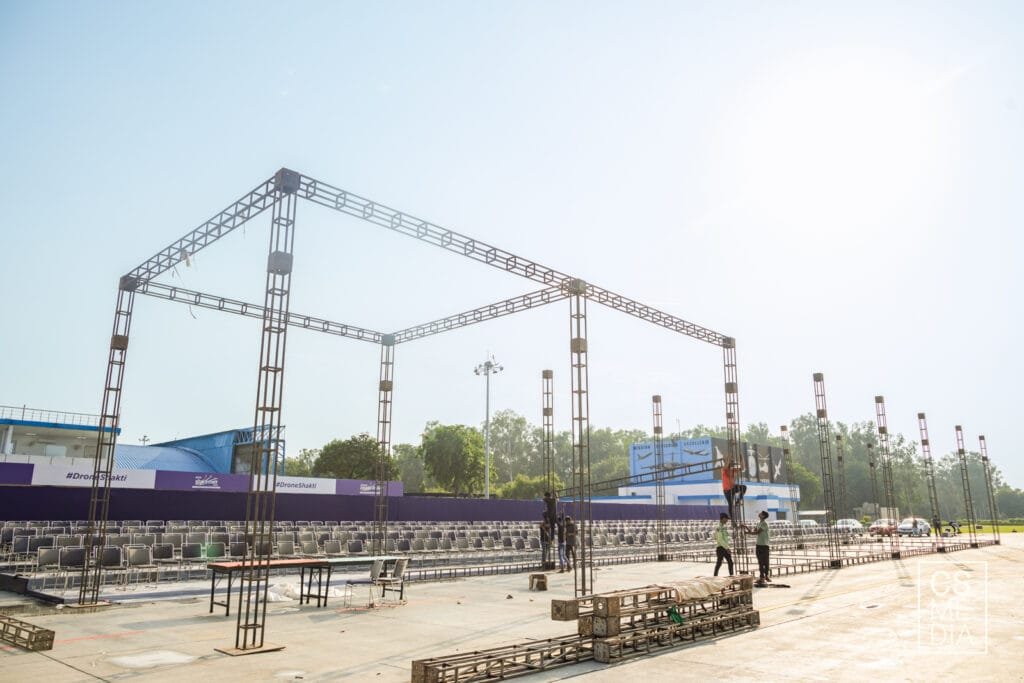
Think about what that actually covers. A stage structure that goes up over three days before a single lighting fixture is mounted. A custom set build where the production design team makes on-the-fly adjustments because the approved renders did not account for the venue’s actual ceiling load. A branding team wrapping pillars and installing signage at midnight because freight arrived six hours late. An AV crew running its fifth system check at 5 AM because the acoustics in every new venue are different from what the specs say. Six to seven days of this – all of it invisibly stacked beneath the two hours the audience experiences. That is what event BTS coverage is built to capture, when it is done properly.
For events across Delhi NCR – corporate summits, brand activations, trade expos, product launches – the production scale is almost always invisible to the audience. What looks like a seamless conference morning was, in most cases, a six or seven day operation run by a crew that never fully stopped. Documenting that operation requires a camera team that understands production rhythms, not just photography principles.
Days and Days - The Setup, the Staging, and the Sweat
Corporate event setup documentation begins before a single cable is run or a single truss is bolted. It starts on Day 1 – often six or seven days out from the event – with an empty venue shell and a production schedule that is already being stress-tested against reality. The production manager arrives with approved drawings, a supplier chain that is never entirely in sync, and a build sequence that will be revised at least twice before the week is out.
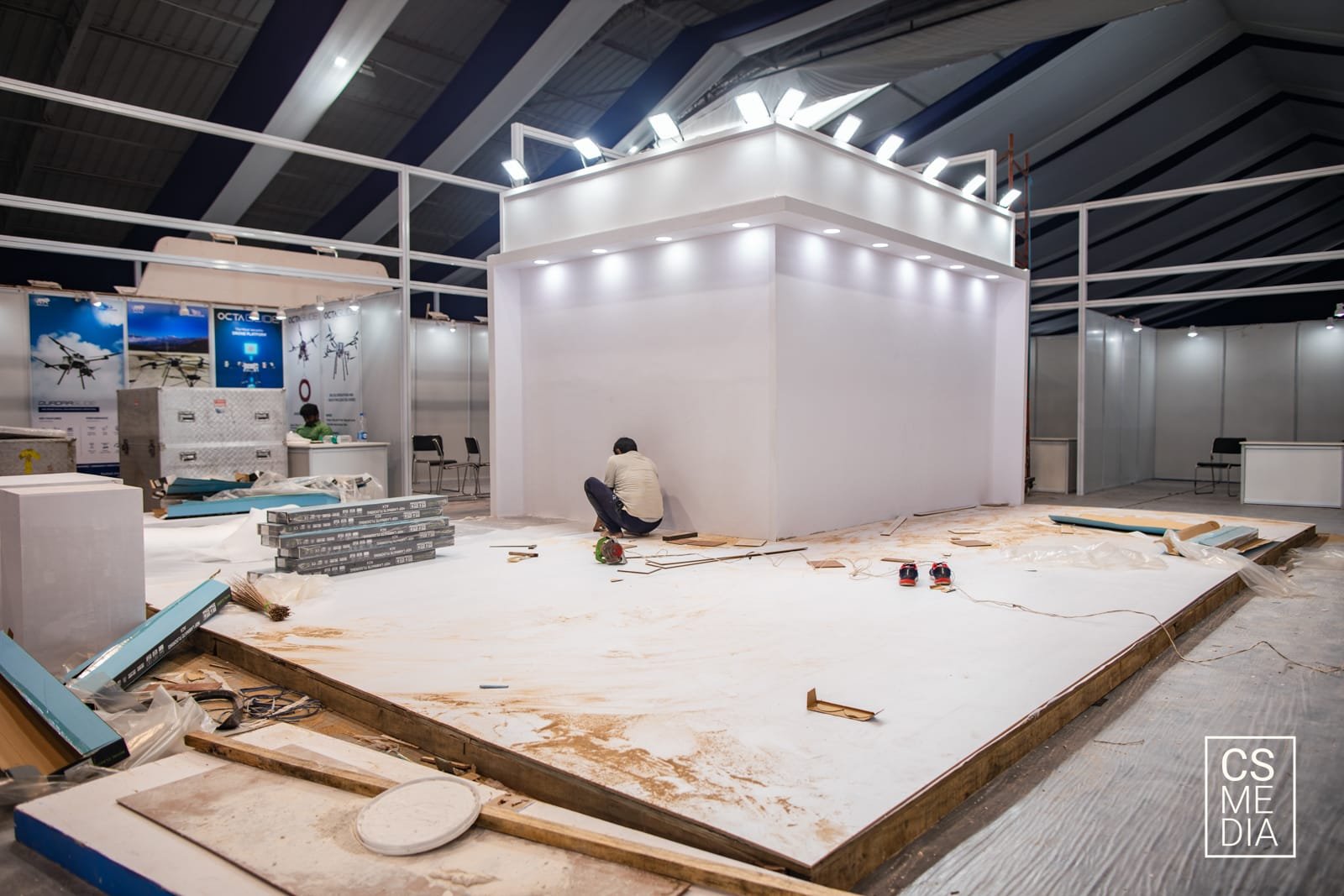
Watch a corporate set-build team work and what you see is structured problem-solving under time pressure. The custom LED wall signed off in the design brief now needs to be reconfigured because the rigging points in this venue are two feet off from where the structural drawings said they would be. The branded stage fascia that looked clean in the render looks completely different once the venue’s ambient lighting hits it. The modular set pieces pre-built in the workshop need to be taken apart and reassembled on-site because the freight elevator maximum clearance is eight inches shorter than the spec sheet stated. Every single day of a corporate production build carries at least three of these moments. None of them make it into the event highlight reel. All of them are exactly what event setup documentation is built to capture.
Stage setup photography tells a different kind of story. The evolution of a bare structure – steel frames, wooden decking, cable runs, lighting rigs into something that reads as a single coherent visual statement is genuinely cinematic. The people doing that work – riggers, carpenters, lighting technicians, set designers move with a precision that looks improvised but is actually deeply rehearsed. Capturing those frames requires a photographer who understands the construction process well enough to anticipate the important moments.
For events in Gurugram and the wider NCR belt, venue logistics add another layer entirely. Load-in schedules, security clearances, freight elevator access times, noise curfews – all of these shape when and how a production team can work. Event setup documentation that captures this reality does not just show what was built. It shows what it took to build it under the constraints that most guests will never know existed.
The Human Grind Behind Every Corporate Event Stage and Set Build
Production coverage is not just about spaces transforming. It is about the people doing the transforming.
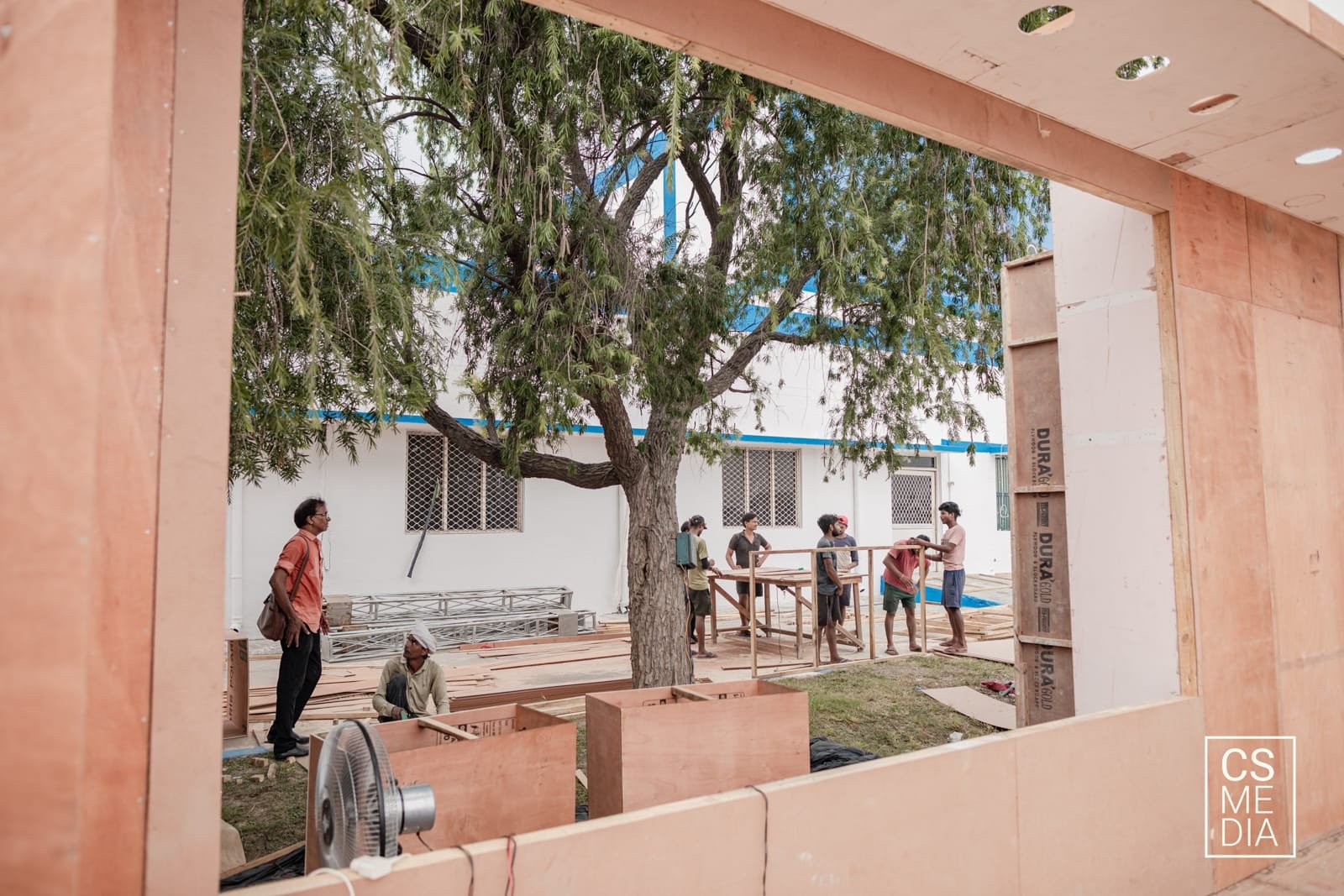
The production head who has been in the venue since Day 1 and has barely left. The junior lighting technician doing a final rig check with a headlamp at 4 AM on Day 6. The site manager who has walked the venue floor more times than she can count – not because she is anxious, but because one more pass might catch the one thing everyone else missed. These are real people doing demanding, physical, relentless work across multiple days, and the best candid event media finds them in the middle of it.
Good BTS photography does not manufacture these moments. It does not ask a production crew member to re-enact a cable pull or look meaningfully at a half-built stage. It earns access through trust and stays present long enough to catch the unguarded ones. The quiet conversation between two technicians resolving a last-minute structural call. The moment a set designer steps back on Day 5 and sees the build finally looking the way the design intent said it should. The small, collective exhale that passes through the crew about forty minutes before doors open. These are the frames that tell the real story.
These are the frames that audiences do not see on the event reel. And they are, in many ways, the frames that carry the most weight. They are the evidence of craft. Of commitment. Of the kind of effort that does not stop until it is right.
Why Behind the Scenes Event Photography and Videography Is a Content Asset
There is a practical case to be made here alongside the emotional one.
Event production photography gives organizers, brands, and production houses a layered content library that a highlight reel alone cannot provide. BTS content operates differently from polished event footage. Where a highlight reel demonstrates the result, production coverage demonstrates the process. And for an audience that increasingly wants to know how things are made – not just what they look like when they are finished – process content builds a different kind of trust.
From a content strategy standpoint, behind the scenes event photography and videography creates three distinct content moments from a single event: teaser content in the days before, production content during the build phase, and reflective storytelling after the event wraps. Each of these moments speaks to a different segment of an audience and serves a different purpose in a content calendar.
For brands and event organizers in competitive markets like Delhi NCR – where the quality and scale of corporate events is high and the visual competition online is significant, this depth of content is a real differentiator. Showing a client what six to seven days of production looks like is a more persuasive statement of capability than any agency deck. Showing an audience the effort behind an event increases their perceived value of the experience they attended.
The BTS reel is not just a nice-to-have. For teams that know how to use it, it is one of the strongest things in their content toolkit.
What Separates Great BTS Coverage from a Walk-Through With a Camera
Not every camera present on a production day will produce meaningful BTS content. The difference between event setup documentation that tells a story and footage that merely records a sequence of actions comes down to a few things.
The first is access. A BTS photographer or videographer needs to be genuinely embedded in the production, not observing from the edges. They need to be trusted enough to be present during planning conversations, direction changes, and moments of difficulty. Without that level of access, the coverage stays surface-level.
The second is reading the room. A production day has its own rhythm – early hours of focused calm, a midday period where things often go sideways, a late afternoon stretch where the pressure compounds, and a final hour of controlled intensity before doors open. Knowing where you are in that rhythm tells you where to be with your camera and what kind of frame to look for.
The third is restraint in the edit. Not every frame of difficulty needs to make it into the final cut. Behind the scenes event photography and videography done well is not a document of everything that went wrong. It is a portrait of how much went into making it right. That distinction lives entirely in selection and sequencing, and it is where craft separates from coverage.
The Frames That Stay When the Event Has Gone
An event lives for a few hours. The work behind it lives for days, sometimes longer. Behind the scenes event photography and videography is the practice of making sure that work is not invisible – that the human grind which produces the polished result gets the same careful frame as the result itself.
The production head who lived in the venue for six days straight. The rigger who finished the truss at 3 AM and was back on-site by 7 AM. The site manager whose attention to detail the audience benefited from without ever knowing her name. The AV engineer who made a 1,200-person room sound effortless. These people, and the days they kept, are the real architecture of every corporate event that looks like it came together without effort.
What stays after you think about this is not any single image. It is the understanding that every seamless event you have ever attended was held together by invisible labour, and that the most honest thing a camera can do is go looking for it. That is what behind the scenes event photography and videography is for. Not the polish. The people behind it.
Your Event Has a Story That Starts Before Day One
Ready to Document the Grind?
Most event photographers show up on the day. The real story starts days before – in the empty hall, the overnight setups, the moments the crew would never think to photograph themselves.
If you are planning an event and want both the BTS and the event itself documented with the same level of craft, CandidShutters Media works across the full production timeline, from first setup day to final frame on the night.
Talk to the team about your next event.
Because the story that starts before the guests arrive is the one worth telling first.
Frequently Asked Questions (FAQs) About Behind-the-Scenes Photography and Videography
1. How can someone get into behind-the-scenes photography, in Corporate events?
To get into behind-the-scenes photography in corporate events, a photographer needs strong event photography skills, quick decision-making, and the ability to work discreetly without interrupting the main production. Understanding event flow, lighting changes, and team coordination is essential. Many professionals start by assisting event photographers or production teams and gradually build a BTS portfolio that highlights authentic working moments from corporate events.
2. What are the Benefits of Behind The Scenes Photos?
Behind The Scenes photos help showcase the real effort, creativity, and teamwork involved in producing an event or campaign. They add authenticity to a brand’s storytelling, strengthen audience trust, and create engaging content for marketing, social media, and internal communications. BTS photos also highlight the scale and professionalism behind corporate productions.
3. What is behind the scene video?
A behind the scene video is a visual documentation of the preparation, coordination, and production processes that happen during an event, shoot, or campaign. It captures candid moments such as crew setup, equipment preparation, rehearsals, and team collaboration, offering viewers a transparent look at how the final event or content is created.
4. What is a behind the scenes photographer?
A behind the scenes photographer is a professional responsible for documenting the working environment, preparation, and creative process during an event or production. Instead of focusing only on the final stage moments, the photographer captures the effort, coordination, and energy that happen off-camera.
5. What to put in a behind the scenes video?
A strong behind the scenes video usually includes preparation shots, crew coordination, equipment setup, rehearsals, candid interactions, and short moments from the actual production process. Including these elements helps viewers understand how the event or project comes together while making the content engaging and authentic.
6. How to shoot a BTS Video?
To shoot a BTS video effectively, filmmakers focus on candid moments, natural interactions, and the workflow of the production team. Using handheld or flexible camera setups, capturing quick interviews or reactions, and documenting setup, rehearsals, and real-time action helps create an engaging behind-the-scenes narrative.
Last updated on March 11th, 2026 at 01:12 pm

CandidShutters Media
Corporate Photography & Video Production Agency · Mumbai & Gurgaon · Est. 2012 · 14+ Years
International : Dubai · Sri Lanka · Malaysia · Thailand · Maldives · Worldwide