Professional Camera Equipment We Use at CandidShutters Media
CandidShutters Media runs a full professional camera equipment setup built for video production, corporate shoots, brand films, and live events. We shoot on Sony A7 IV, A7 V, A7S III, and FX3 bodies with Sony G Master and Sigma Art lenses. Aerial work is covered by DJI Mavic Pro 2 and FPV drones. Audio runs through Sennheiser and Hollyland wireless systems. Lighting is handled by Godox strobes, LED panels, and modifiers. Every piece of gear in our kit is chosen for one reason: to make your production look and sound world-class.
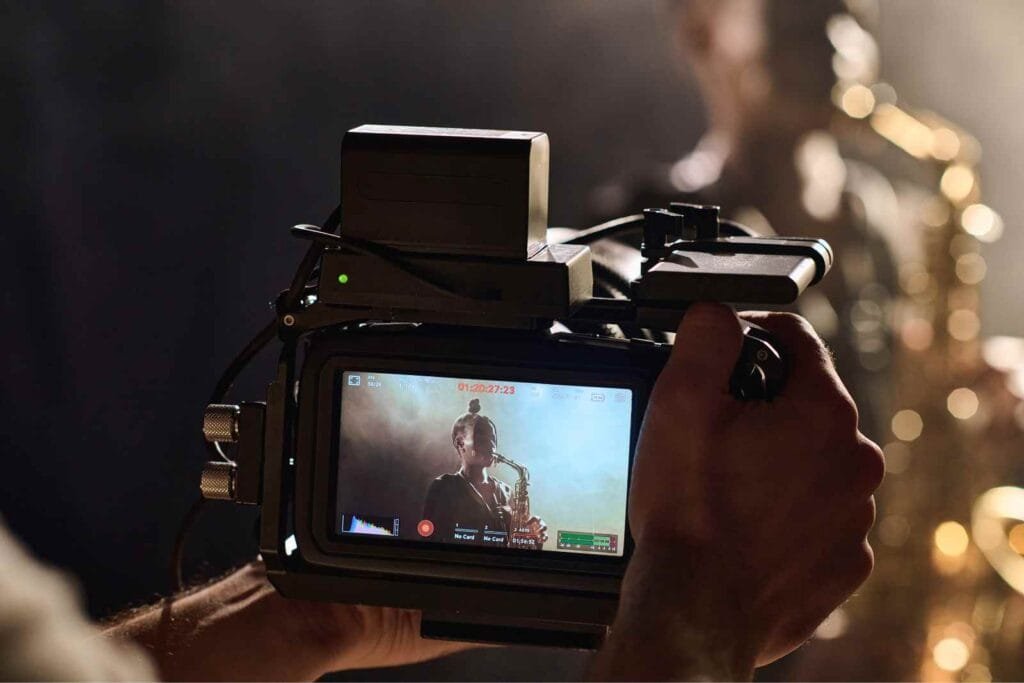
When clients ask what makes CandidShutters Media different, the answer has two parts: the people behind the camera, and the professional camera equipment in front of them. This post covers both in full detail.
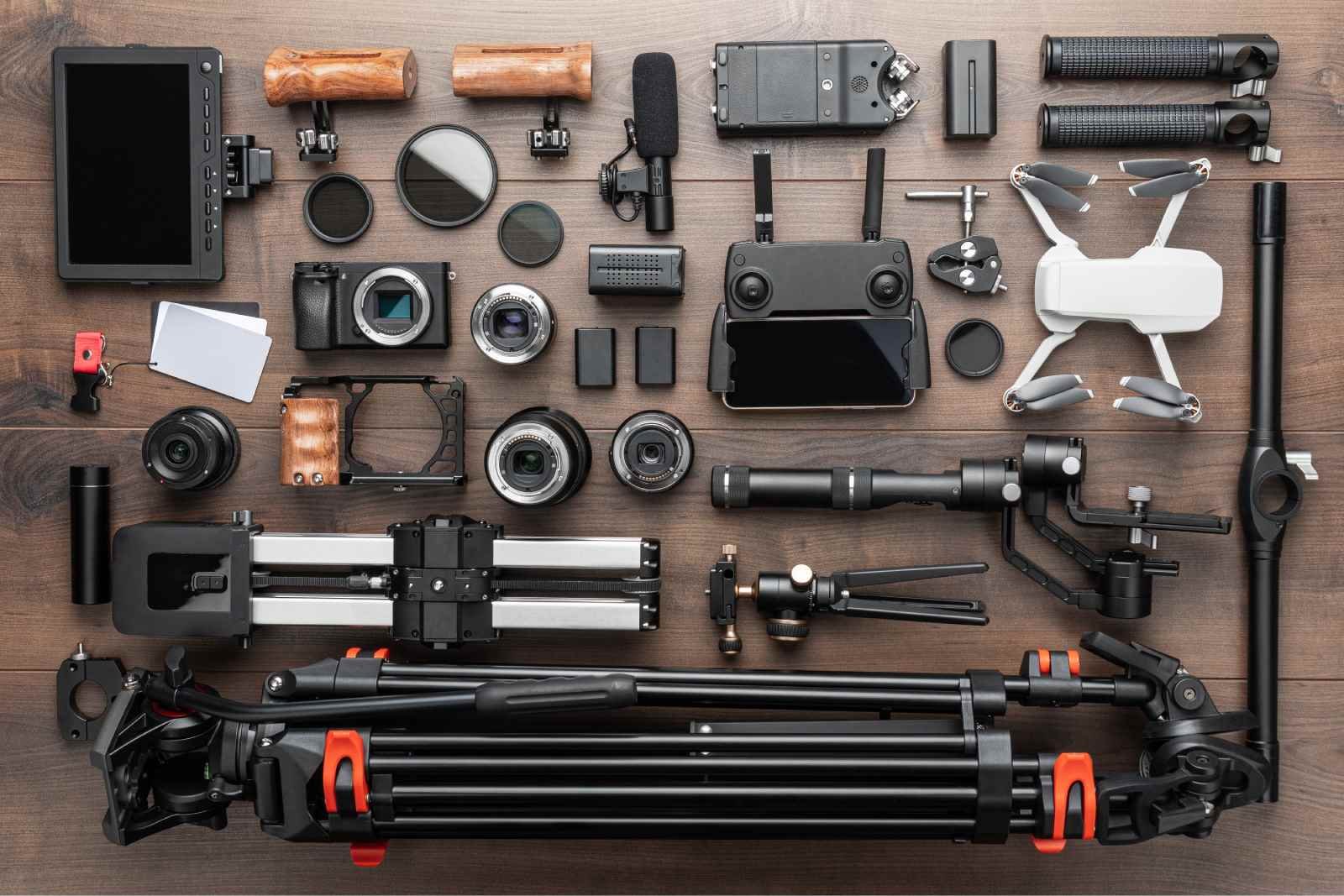
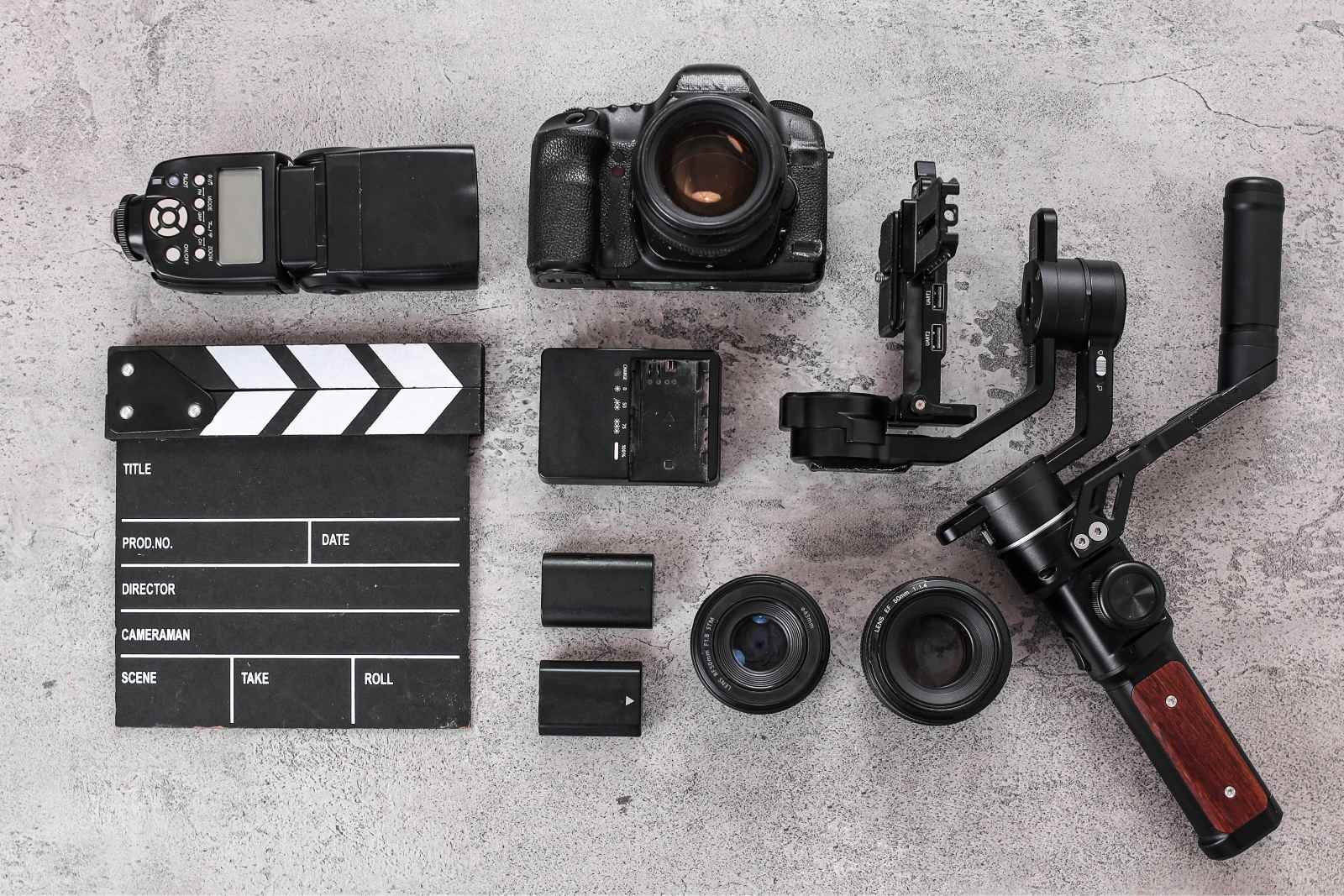
Below is a complete, transparent breakdown of every major piece of professional camera equipment for video production that CandidShutters Media operates. Cameras, lenses, drones, stabilisers, lights, audio, storage, and live relay – all explained in plain language so you know exactly what goes into every project we deliver.
Whether you are a marketing head commissioning a brand film, an HR team planning an employee engagement shoot, a C-suite leader preparing for a corporate announcement, or an event planner sourcing a production partner – this is the full picture.
Photography Camera Setup
STILLS & HYBRID PHOTOGRAPHY
Our photography cameras are built on the Sony Alpha full-frame mirrorless system – the most capable professional mirrorless platform available today for demanding photography across events, corporate shoots, and brand productions.
Sony A7 IV – Primary Photography Body
PRIMARY PHOTOGRAPHY BODY
33 megapixels. Phase-detect autofocus across the entire frame. 10-bit 4K video capability. The A7 IV is our core photography body for corporate headshots, product photography, editorial shoots, and event coverage. Its dynamic range and colour reproduction deliver consistently excellent results across all lighting conditions – from controlled studio setups to mixed-light conference venues.
Sony A7 V – Next-Generation Flagship
NEXT-GENERATION FLAGSHIP
Sony’s latest Alpha 7 flagship introduces an AI-driven autofocus system with near-perfect subject tracking, improved low-light output, and enhanced computational imaging. The A7 V is already deployed on high-demand projects where speed, accuracy, and image quality cannot be compromised.
Photography Lenses
OPTICS
Cameras are one half of the equation. Lenses determine sharpness, character, background compression, and how light renders in the final image. Our photography lens kit covers every focal length a professional production demands.
Why Sony G Master II Lenses Are the Gold Standard in Professional Production
If there is one lens family that consistently defines the visual standard of world-class production work, it is the Sony G Master II series. These are not incremental upgrades – they represent Sony’s most advanced optical engineering applied to the demands of professional cinematography and photography at the highest level.
The G Master II lenses are built around Sony’s XA (extreme aspherical) elements – precision-ground to tolerances measured in nanometres. This eliminates the field curvature and chromatic aberration that compromise lesser optics, particularly when shooting wide open. For a production house, this means every frame – a tight portrait, a wide venue shot, a moving subject tracked at f/2.8 – holds edge-to-edge sharpness with no compromise.
The autofocus architecture in the II-series is equally significant. Dual linear motors drive the focus group with near-instantaneous response, operating near-silently – critical on video productions where any mechanical focus noise is captured by the audio system. On a live event or documentary shoot, missed focus is not recoverable in post. G Master II lenses simply do not miss.
The II-series redesigns also addressed weight and balance. The 70-200mm f/2.8 GM II is substantially lighter than its predecessor while improving optical performance across every measurable metric. On a gimbal like the Ronin RS 5 Pro, reduced lens weight directly improves stabilisation accuracy and extends shooting time without operator fatigue – in a full-day event or multi-location shoot, that is a practical advantage that compounds over hours.
What G Master II glass ultimately delivers on set is predictability. Every production house’s worst outcome is inconsistency – frames that look different because the lens behaved differently under different conditions. G Master II lenses render colour, contrast, and bokeh with complete consistency across the frame, across lighting conditions, and across focal lengths. That consistency is what lets footage cut together cleanly in post, and it is why these lenses anchor every CandidShutters Media kit configuration.
For events and documentaries specifically, G Master II is the undisputed gold standard, and the reason is straightforward. Events do not offer second takes. A keynote speaker walks on stage once. A product launch moment happens once. A documentary subject’s most candid, unguarded expression happens once. In those conditions, a lens that hesitates on focus, renders flat in low light, or loses sharpness at the edges of the frame is not a minor inconvenience, it is a missed shot that cannot be recovered. G Master II glass eliminates that risk. The combination of near-silent dual linear autofocus, wide aperture performance with no optical compromise, and consistent rendering in mixed or challenging light makes it the only lens family CandidShutters Media trusts on productions where there is no margin for error.
There is a misconception worth addressing directly: the camera body does not determine the quality of what you see on screen, the lens does. Two productions can shoot on the identical Sony FX3 body. One uses a G Master II lens. The other uses a generic kit lens. The footage will look categorically different – not subtly different, not “noticeable only to experts” different. The depth of field rendering, the way background elements dissolve into smooth bokeh, the microcontrast that gives subjects a three-dimensional quality, the colour accuracy that holds across the tonal range – all of this comes from the glass, not the sensor. The body captures what the lens delivers. When that lens is a G Master II, what gets delivered to the sensor, and ultimately to the screen is something a standard lens simply cannot produce. This is why production houses that take output quality seriously do not compromise on optics, regardless of the camera body in use.
Sony FE 16-35mm f/2.8 GM II
WIDE-ANGLE WORKHORSE
Razor-sharp wide open. Our go-to for venue interiors, group coverage, and environmental photography. Built to Sony’s highest G Master optical standard.
Sony FE 70-200mm f/2.8 GM II
TELEPHOTO – EVENTS & COVERAGE
Fast, silent telephoto. Built for candid event coverage, speaker photography, and compressed background separation in live settings.
Sony FE 85mm f/1.4 GM II
PORTRAIT LENS
At f/1.4, subjects pop against a background render that defines CandidShutters Media’s premium portrait look. This lens defines the visual identity of our corporate portrait work.
Sigma 14-24mm f/2.8 DG DN Art
ULTRA-WIDE PRECISION
For architecture, large-scale venues, and dramatic environmental frames – exceptional corner-to-corner sharpness throughout.
Sigma 35mm f/1.4 DG DN Art
DOCUMENTARY & STORYTELLING
One of the sharpest 35mm lenses available. Used for documentary-style and storytelling frames – wide enough for context, intimate enough for emotion.
Video Production Camera Setup
CINEMA & VIDEO
CandidShutters Media’s video production cameras are chosen specifically for cinema-grade output – not consumer video, not hybrid compromise. Full-frame sensors, professional colour science, and broadcast-ready specifications are the baseline for every production.
Sony A7S III – Low-Light Specialist
LOW-LIGHT SPECIALIST
The benchmark for professional camera equipment for video production in low-light environments. 4K up to 120fps, an ISO range that performs in the most challenging real-world conditions, and 10-bit 4:2:2 colour depth straight out of the camera. For corporate events with mixed lighting, indoor brand films, and any shoot where light control is limited, the A7S III is the first choice.
Sony FX3 – Primary Cinema Camera
PRIMARY CINEMA CAMERA
Sony’s dedicated cinema camera – built for production houses and professional crews. Active cooling means it records as long as a shoot demands. Full-frame 4K at 120fps, cinema-line colour science, and a compact body that pairs perfectly with our gimbal and rigging configurations. The FX3 is the primary cinema camera in every CandidShutters Media brand film, corporate production, and event cinematic we deliver.
Gimbal Stabilisation
CAMERA MOVEMENT
DJI Ronin RS 5 Pro
THREE-AXIS MOTORISED GIMBAL
Smooth, controlled camera movement is what separates a professional film from an amateur one. The RS 5 Pro handles our full Sony FX3 and lens configurations with ease – enabling tracking shots, reveal moves, walk-and-talk sequences, and dynamic transitions without a full rigging crew. A critical piece of our professional camera equipment for video production on every project.
Drone & Aerial Coverage
AERIAL
Aerial footage adds scope and production value that no ground-based camera can replicate. CandidShutters Media operates two drone platforms depending on what a project needs.
DJI Mavic Pro 2 – Primary Aerial Camera
STANDARD AERIAL PLATFORM
1-inch CMOS sensor with Hasselblad colour tuning, 4K video, and reliable obstacle avoidance. Standard deployment on corporate events, location shoots, and brand productions that need clean, high-quality aerial perspectives.
FPV Drones – High-Energy Aerial
HIGH-ENERGY AERIAL PLATFORM
For productions that need immersive aerial footage – fast flybys, dynamic reveal shots, or low-altitude chase sequences. FPV delivers visual energy impossible to achieve any other way, deployed by project requirement.
“Aerial footage adds a dimension that changes how an audience experiences a location. It’s not decoration – it’s storytelling from a perspective no human eye can reach.”
Static & Multi-Camera Event Coverage
LIVE EVENTS & CONFERENCES
Large-scale corporate events, conferences, and live productions need dedicated static camera coverage alongside the primary cinematic setup. We use the Sony Z280 – a professional broadcast camcorder trusted by production companies and broadcast networks worldwide – for static long-format coverage, secondary angles, and live relay feeds. It handles 4K HDR recording with the reliability that live event production demands.
Professional Lighting Setup
LIGHTING & MODIFIERS
Lighting is where a production either looks professional or amateur. CandidShutters Media runs a full, scalable lighting infrastructure across strobes, continuous panels, and speciality fixtures.
Flash & Strobe Systems
GODOX AD200 PRO
Portable strobe for outdoor and high-power applications – overpowers ambient daylight when needed.
GODOX V1 PRO
Round-head on-camera flash for portraits and event fill lighting – natural, even falloff.
GODOX TT685
High-speed sync speedlight for multi-flash setups and fast-moving event coverage.
GODOX WIRELESS TRIGGERS
Reliable multi-channel remote firing across large venues – no sync cables, full creative freedom.
Continuous & Panel Lighting
GODOX LC500 LED PANELS
Our continuous lighting workhorses for video interviews, corporate shoots, and controlled environments.
HAKO SPOTLIGHTS
Hard-light fixtures for fashion, commercial, and theatrical-style productions.
RING LIGHTS
Clean, flattering light for close-up interview setups and social content production.
SOFTBOXES & GODOX AKR1 MODIFIERS
Light shaping tools that let us craft exactly the quality and direction of light each scene requires.
Professional Audio Equipment
SOUND
At CandidShutters Media we treat audio with the same seriousness as the camera setup. Clean dialogue and crisp ambient sound are non-negotiable on every production – because poor audio kills otherwise excellent footage.
SENNHEISER WIRELESS LAPEL MICS
The broadcast-standard wireless lav system. Used on all scripted productions, corporate interviews, and speaker coverage where audio quality cannot be compromised.
HOLLYLAND LARK WIRELESS MICS
Compact and fast to deploy. Our choice for live events and documentary-style shooting where subjects are moving and time is short.
RODE VIDEOMIC SERIES
On-camera directional microphones for run-and-gun video and field production.
AUDIO-TECHNICA HEADPHONES
Professional closed-back reference headphones for on-set audio monitoring. What we hear is what gets recorded.
Support Gear, Storage & Live Production
INFRASTRUCTURE
Stabilisation & Support
MANFROTTO TRIPODS & MONOPODS
Industry-standard stability systems for photography and video across all conditions – from conference stages to outdoor locations.
TELEPROMPTER SETUP
For scripted corporate video, spokesperson shoots, and any production where on-camera confidence and message accuracy matter.
Filters
NISI VARIABLE ND FILTERS
High-quality neutral density filters for exposure control outdoors and achieving cinematic motion blur in video – essential for any outdoor production.
Storage & Media
SONY TOUGH G CFEXPRESS CARDS
Professional-grade, weatherproof high-speed media. Fast enough for 4K RAW and high-frame-rate burst capture without a dropped frame.
SANDISK EXTREME PRO SSDs
Field backup and media transfer drives. Rugged and fast – because data security on a production is absolute.
Live Relay & Streaming
ELGATO LIVE RELAY & CAPTURE SYSTEM
Enables live streaming, hybrid event broadcast support, and real-time content delivery for corporate productions and large-scale events.
Why The Right Camera Equipment Matters for Your Production
Professional camera equipment for video production is not about brand names or spec sheets. It is about reliability, image quality, and what the final output looks and sounds like to your audience. Underpowered gear introduces noise, compression, unreliable autofocus, and audio issues that no amount of post-production can fully fix.
For a marketing head signing off on a brand film, a C-suite leader going on camera for a corporate announcement, an HR team running an employee testimonial series, or an event planner delivering a memorable conference – the quality of the production equipment determines the quality of the result.
At CandidShutters Media, every camera, lens, light, and microphone in this list was chosen because it performs at the level our clients and their audiences expect. Whether it is a 30-second brand film, a full-day corporate event, or a multi-location documentary shoot – the equipment is ready. The crew knows it inside out. And the output holds up on any screen, from a smartphone to a boardroom display.
FREQUENTLY ASKED QUESTIONS
1. What is the difference between Sony A7S III and Sony FX3 for video production?
Both cameras share the same full-frame sensor and deliver exceptional 4K video, but the FX3 is Sony’s dedicated cinema camera – built with active cooling for extended recording, a rugged cinema-line build, and better compatibility with professional rigging. The A7S III is more compact and excels in extreme low-light with its wider ISO range. For long-format brand films and corporate productions, the FX3 is the primary choice. For fast-moving event coverage in difficult lighting, the A7S III is unmatched.
2. What is the Sony G Master lens series and why is it used for professional shoots?
Sony G Master lenses are Sony’s highest-tier professional optics, engineered for exceptional sharpness, beautiful background blur, and fast near-silent autofocus. Every G Master lens performs at peak quality wide open – meaning you get cinematic results at f/1.4 or f/2.8 without stopping down. For professional video production and photography, this translates into sharper subjects, smoother focus pulls, and a more cinematic final image.
3. What is the difference between Sigma Art lenses and Sony G Master lenses?
Both are professional-grade optics, but optimised differently. Sigma Art lenses prioritise maximum optical resolution at an exceptional price point. Sony G Master lenses are engineered specifically for the Sony Alpha system – delivering faster, quieter autofocus, better stabilisation compatibility, and lighter builds in the II-series versions. On a production, both deliver excellent results; the choice depends on focal length and intended use.
4. What is an FPV drone and how is it different from a standard camera drone?
A standard camera drone like the DJI Mavic Pro 2 flies in a stabilised, controlled manner – ideal for sweeping wide shots and clean overhead coverage. An FPV drone is a manually piloted racing-style rig that flies at high speed, dives, banks sharply, and navigates tight spaces — producing immersive, kinetic footage impossible to achieve any other way. FPV is deployed when a production needs high-energy aerial sequences.
5. What is the DJI Ronin RS 5 Pro gimbal used for in video production?
The DJI Ronin RS 5 Pro is a motorised three-axis stabiliser that counteracts unwanted camera movement in real time. It allows an operator to walk, run, or track a subject while the camera stays perfectly smooth – enabling tracking shots, walk-and-talk sequences, and dynamic transitions. The RS 5 Pro is specifically built for professional cinema cameras and heavy lens configurations.
6. What is the difference between a Godox strobe and a continuous LED light?
A strobe fires a powerful burst of light in sync with the camera shutter – used in photography to freeze motion and overpower ambient light. A continuous LED panel stays on throughout a shoot, providing a constant controllable source essential for video production. In professional setups, both are used together: strobes for photography and stills work, LEDs for video and interview setups.
7. Why do professional productions use wireless lapel microphones instead of a camera’s built-in mic?
Built-in camera microphones capture everything around the camera – ambient noise, handling noise, and room echo – with very little ability to isolate the speaker’s voice. A wireless lapel microphone clips directly onto the subject and captures clean, close-up audio with minimal background interference. In corporate events, interviews, and brand films, the difference between a camera mic and a professional wireless lapel system is immediately noticeable.
8. What are NiSi Variable ND filters and when are they used in video production?
An ND filter acts as a dimmer for your camera lens, reducing light intake without affecting colour. A variable ND lets you adjust the reduction level on the fly. In video production, this is essential for shooting outdoors in bright conditions while maintaining a wide aperture for shallow depth of field and a cinematic shutter speed. Without an ND filter, outdoor footage shot at the correct cinematic shutter speed would be severely overexposed.
Last updated on April 10th, 2026 at 08:13 pm
A full breakdown of the cameras, lenses, drones, lights, and audio gear behind every production we deliver from brand films to live events.

CandidShutters Media
Corporate Photography & Video Production Agency · Mumbai & Gurgaon · Est. 2012 · 14+ Years
International : Dubai · Sri Lanka · Malaysia · Thailand · Maldives · Worldwide